2026 POLYVAGAL INSTITUTE INTERNATIONAL GATHERING
Hidden in Plain Sight
When Adaptive Functioning Masks Ongoing Autonomic Burden
A Practice-Based Clinical Observation
Sheryl Daniel, LGPC, NCC
Certified Brainspotting Practitioner
Sheryl Daniel Counseling | Holding Space LLC
Sitges, Spain · September 22–24, 2026
Thank you for continuing the conversation.
Hidden in Plain Sight grew from a practice-based observation: people may appear calm, capable, insightful, responsible, or “well-regulated” while carrying persistent autonomic, emotional, cognitive, and relational burden beneath what is visible.
Choose where you'd like to begin.
THE POSTER
Explore the complete conference presentation.
BEYOND THE POSTER
Hear the thinking behind the clinical observation.
THE INQUIRY CONTINUES
Explore reflections and questions emerging from the work.
The Poster
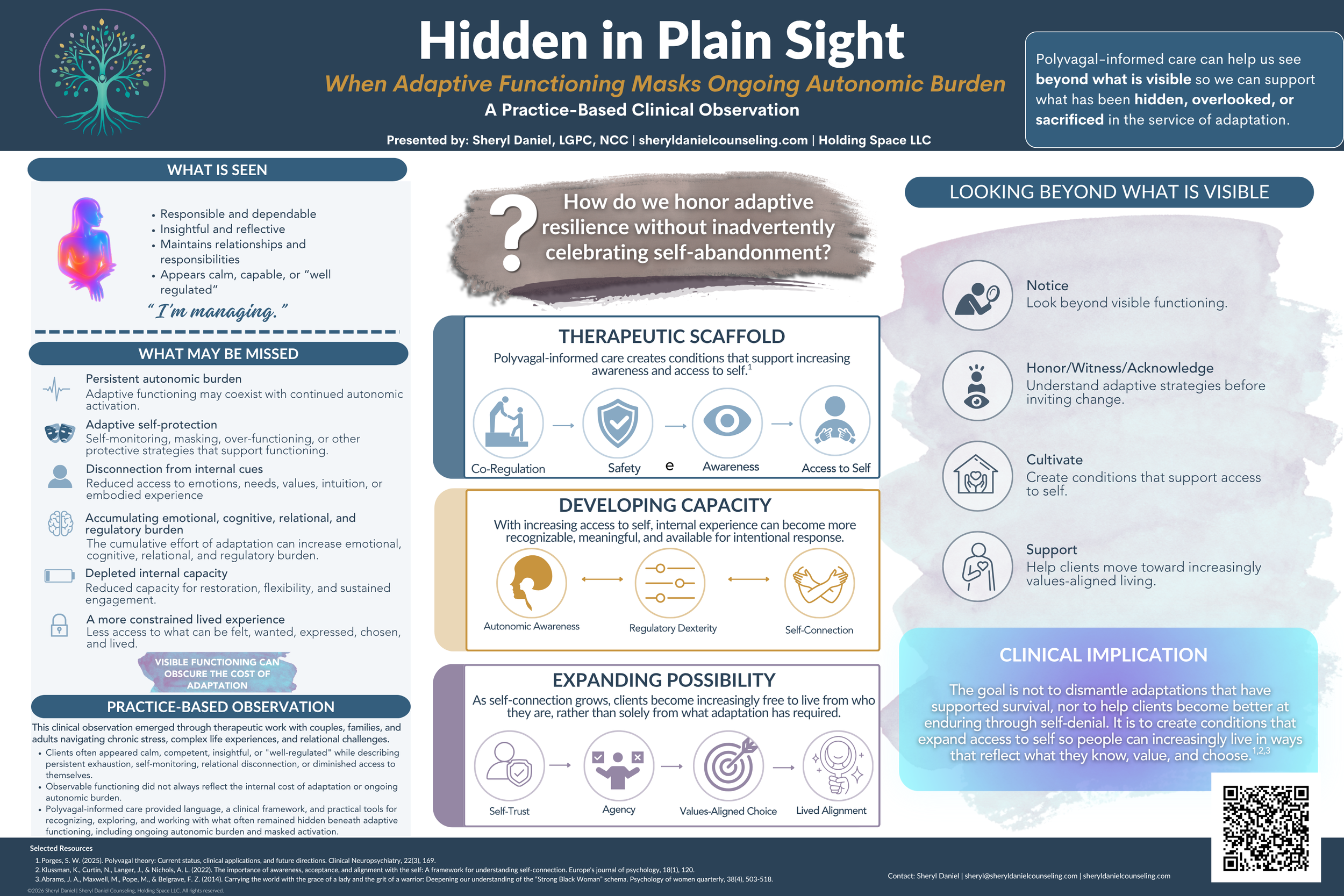
Select the poster to view the full-size PDF.
Presented at the 2026 Polyvagal Institute International Gathering in Sitges, Spain.
Beyond the Poster
What I Was Noticing in the Room
Hidden in Plain Sight began with a clinical tension: people can be insightful, capable and outwardly functioning while their nervous systems continue to carry the cost of adaptation.
In this brief reflection, I share how applying a Polyvagal-informed lens in clinical practice led me to look more closely at what may be carried beneath visible functioning—and to ask what becomes possible when regulation is understood not as the endpoint, but as part of creating greater access to self.
The Inquiry Continues
Hidden in Plain Sight began with a practice-based clinical observation. The questions it raised have continued to evolve through clinical practice, reflection, scholarship, and conversation.
What follows is not an expansion of the original poster, but a glimpse into where the inquiry is leading.
Select a reflection to explore.
-
Visible capability may tell us what a person can continue to do. It does not necessarily tell us what doing it requires of their system.
Visible functioning may coexist with exhaustion, persistent self-monitoring, relational disconnection, diminished access to internal cues, or an autonomic system working hard to maintain what others experience as competence.
What becomes visible when we become curious about the cost of functioning, not only the functioning itself?
-
Behaviors that appear rigid, avoidant, controlling, overly responsible, or self-sacrificing may make greater sense when understood in the context in which they developed.
Before inviting change, we can become curious about what an adaptive response has helped a person protect, preserve, survive, manage, or maintain.
What changes when we ask not only “What is this response doing?” but “What has it been doing for you?”
-
“I’m good.” “I’ll be okay.” “I’ve got it.”
These statements may be true. They may also help someone continue moving when exhaustion, disconnection, unmet need, or depletion is already present.
Rather than challenging the “okay,” we can allow it to remain true while making room for more:
I’m okay—and what else is true?
Capable and depleted. Managing and carrying. Knowing I’ll get through it and noticing what getting through it is requiring of me.
-
A distinction I heard Tracy Gantlin-Monroy make on the Beyond the Spot podcast has remained an important through-line in my thinking: regulation does not equal healing.
Regulation may create greater capacity and possibility, but becoming calmer—or becoming more skilled at managing one’s nervous system—is not necessarily the endpoint.
The developing inquiry is increasingly concerned with what sufficient safety, awareness, and regulation may make more accessible: self, connection, agency, meaningful choice, and increasingly values-aligned living.
What becomes possible when regulation supports access rather than becoming the destination?
If something in Hidden in Plain Sight resonates with your clinical work, professional interests, or lived experience, there are several ways to continue the conversation.
CLINICAL WORK & BRAINSPOTTING
Explore relational, trauma-informed therapy and Brainspotting services for individuals and couples.
Continue Exploring
CONSULTATION & PROFESSIONAL CONVERSATION
Connect around clinical application, emerging ideas, collaboration, or shared areas of inquiry.
RESOURCES & REFLECTIONS
Explore resources and reflections designed to support self-awareness, meaning-making, and greater access to self.
SPEAKING & COMMUNITY WELLNESS
Explore opportunities for presentations, workshops, professional learning, and community-centered wellness experiences.
Foundational References
References & Influences
Hidden in Plain Sight is grounded in existing scholarship and emerged from practice-based clinical observation. The continuing inquiry is also shaped by emerging research, professional learning, clinical dialogue, and ideas encountered across disciplines.
Porges, S. W. (2025). Polyvagal theory: Current status, clinical applications, and future directions. Clinical Neuropsychiatry, 22(3), 169–184.
Supports the Polyvagal-informed foundation for understanding autonomic responses, protection, adaptation, co-regulation, safety, and connection.
Klussman, K., Curtin, N., Langer, J., & Nichols, A. L. (2022). The importance of awareness, acceptance, and alignment with the self: A framework for understanding self-connection. Europe’s Journal of Psychology, 18(1), 120–131.
Informs the developing emphasis on awareness, acceptance, self-connection, and alignment between internal experience and lived behavior.
Abrams, J. A., Maxwell, M., Pope, M., & Belgrave, F. Z. (2014). Carrying the world with the grace of a lady and the grit of a warrior: Deepening our understanding of the “Strong Black Woman” schema. Psychology of Women Quarterly, 38(4), 503–518.
Provides an important culturally situated lens on expectations of strength, self-reliance, emotional containment, and caregiving among Black women.
Continuing Inquiry
Joseph, J. (2025). High Functioning: Overcome Your Hidden Depression and Reclaim Your Joy. Little, Brown Spark.
Offered an important lens for considering how internal distress, depletion, and disconnection may coexist with maintained outward functioning, and helped extend my thinking about what functioning can obscure.
Joseph, J. F., Tural, U., Joseph, N. D., Mendoza, T. E., Patel, E., Reifer, R., & Deregnaucourt, M. (2025).Understanding high-functioning depression in adults. Cureus, 17(2), e78891.
Provides an emerging research context for examining high-functioning depression and the coexistence of depressive experience with preserved functioning.
Cook, J., Hull, L., Crane, L., & Mandy, W. (2021). Camouflaging in autism: A systematic review. Clinical Psychology Review, 89, 102080.
Extends consideration of masking and camouflaging, including the potential costs associated with maintaining an outward presentation that may obscure aspects of internal experience.
Gantlin-Monroy, T. Beyond the Spot: Decolonizing Healing One Brain at a Time [Podcast].
Her work has been an important influence on my continuing thinking about regulation, healing, adaptation, belonging, and what becomes possible beyond survival.
Gantlin-Monroy, T. (2026). When belonging hurts: Healing after community wounds, betrayal, and exile (Episode 36) [Audio podcast episode]. In Beyond the Spot: Decolonizing Healing One Brain at a Time. Extends the continuing inquiry into belonging, relational and community wounds, nervous-system protection, authenticity, and healing that does not require self-abandonment.
About Sheryl
Sheryl Daniel, LGPC, NCC, is a therapist and Certified Brainspotting Practitioner whose work is grounded in relational, trauma-informed, culturally responsive care.
Her clinical work is shaped by curiosity about what people carry beneath what is readily visible, particularly when capability, responsibility, insight, and adaptation can make internal burden easier to overlook.
Drawing from Polyvagal-informed practice, relational and attachment perspectives, Brainspotting, and mind-body approaches, Sheryl works with individuals, couples, and families to support greater awareness, connection, agency, and access to self.
Hidden in Plain Sight reflects an evolving area of clinical inquiry within that work: how we can honor the adaptations that have helped people survive, function, and remain connected while also becoming curious about their cost and about what might become possible beyond them.
Let’s Stay Connected
I welcome conversation with clinicians, researchers, educators, community partners, and others who are exploring similar questions—or who simply found something here that resonated.

Sheryl Daniel, LGPC, NCC
Certified Brainspotting Practitioner
Sheryl Daniel Counseling | Holding Space LLC